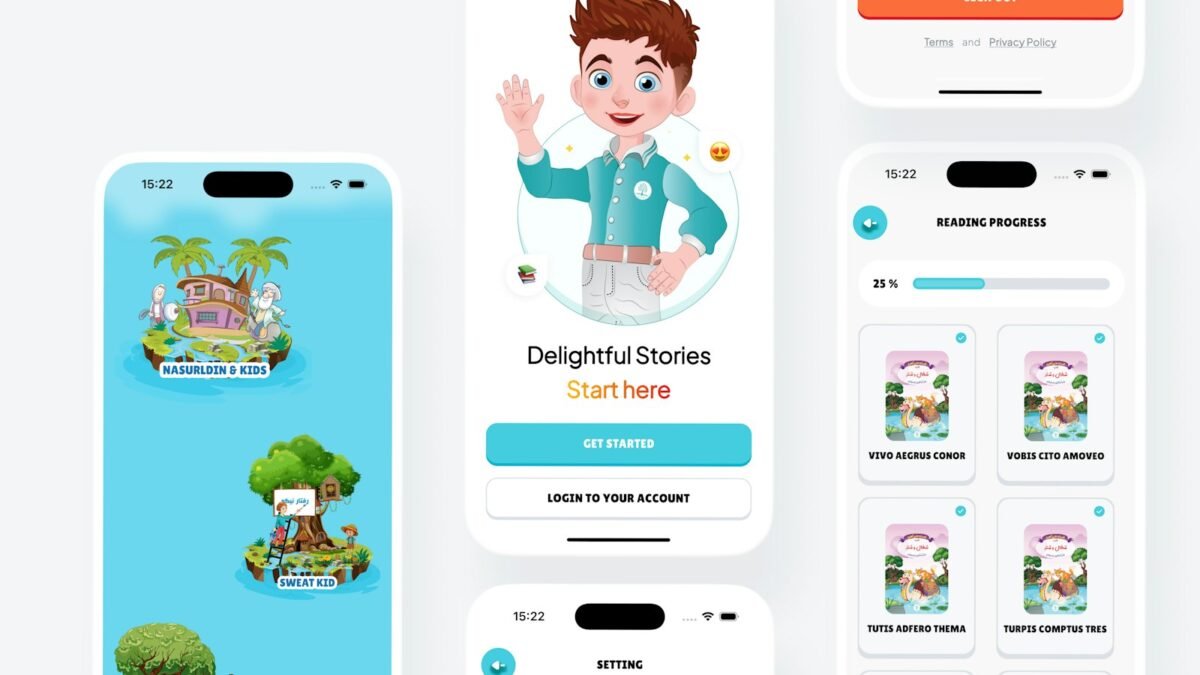
Parents looking for educational apps now face a market in which almost every product claims to use artificial intelligence. Some of those claims amount to little more than adaptive quizzes; others involve speech recognition, computer vision or generative models that change what a child can do with a screen. This guide groups the more established options by age and notes where AI actually plays a role. Prices, features and age ratings change often, so check the app store listing and try an app yourself before handing it to a child.
Ages 5 to 7
Khan Academy Kids is a free app from the nonprofit Khan Academy for children aged roughly 2 to 7. It covers early math, reading and social-emotional skills through games, books and songs, and adjusts the sequence of activities to each child’s progress. It carries no ads and no subscription, and it runs on Android and iOS.
Read Along, from Google, helps children aged 5 to 10 practice reading aloud. An animated reading companion named Diya listens through the microphone, helps with difficult words and awards stars for correct reading. The speech recognition runs on the device, so the app works offline after the initial download. It is free with no ads or in-app purchases, available on Android and on the web.
Buddy.ai is a voice-based English tutor for children aged 3 to 8. Children talk with a cartoon character, and the app’s speech recognition gives feedback on pronunciation while teaching letters, basic vocabulary, numbers, colors and shapes. A basic version is free; additional lessons require a subscription. Android and iOS.
Lingokids offers more than 1,200 activities for ages 2 to 8 across math, English, reading, science, art and music, delivered as games, stories and songs. The app adjusts difficulty based on a child’s answers. A limited free tier allows one profile; a Plus subscription adds offline use, more profiles and more content. Android and iOS.
Ages 8 to 12
Duolingo is the best-known language app for children and adults. Lessons in Spanish, French and dozens of other languages are structured as short games, and the app uses machine learning to adjust review timing and difficulty. The free version includes the full course content with ads; an optional subscription removes ads and adds features. Android, iOS and web.
Prodigy is a fantasy role-playing game in which children aged 6 to 12 answer math questions to advance. The platform assesses each student’s strengths and gaps and adjusts the questions accordingly. The educational content is free; an optional membership unlocks cosmetic game features such as character customization and pets. Web, Android and iOS.
Scratch with Machine Learning for Kids combines MIT’s free block-based coding platform for children aged 7 and up with ML for Kids, a free extension that lets children train simple models to recognize text, images, sounds or numbers and use them in their own Scratch projects. A child can build a game that responds to spoken words or recognizes drawings, and in doing so learn how training data shapes a model’s behavior. Both run in a web browser.
Cognimates, developed at the MIT Media Lab, is an open-source platform built on Scratch for children aged roughly 7 to 13. Children program games and stories and also train machine learning models, for example teaching a chatbot or an image classifier, with activities designed to raise questions about how AI works and where it can go wrong. It is free and runs in a browser.
Ages 13 and up
Khan Academy covers math, science, computer science, history and other subjects from middle school through early college with videos, exercises and quizzes. Each student gets a personalized dashboard that highlights weak areas, and the organization has added an AI tutor, Khanmigo, that guides students through problems rather than giving answers. Course content is free and the nonprofit is donor-funded. Web, Android and iOS.
Photomath, now owned by Google, solves math problems from a photo taken with the phone camera and shows step-by-step working for algebra, geometry and other high school topics. Basic step-by-step solutions are free; a paid Plus tier adds deeper explanations for harder problems. Android and iOS.
AI Dungeon is a text adventure in which a generative AI writes the story in response to whatever the player types. It can encourage creative writing and imaginative thinking, and a basic version is free on Android, iOS and the web, with a subscription for more capable models. Because the content is open-ended and generated on the fly, it is rated for teenagers and warrants parental attention to what is being produced.
A note on Socratic
Socratic by Google, a homework help app that appeared on many lists of this kind, has been discontinued. Google folded its photo-based homework features into Google Lens, which is where students will now find similar functionality.
Before you download
An app that adapts to a child’s pace can be genuinely useful, but no app replaces a parent or teacher who notices what a child finds hard. Review each app’s privacy policy, check what data it collects from a child’s device, and spend time using it together before leaving a child alone with it.